Forming a nonprofit is a one-time job. Keeping it in good standing is a yearly routine with filings to the State of Florida, FDACS and the IRS, each on its own schedule. Miss one, and you can lose your active status, your fundraising registration or even your tax exemption.
Here is every recurring filing in one place, with a month-by-month calendar you can copy.
For general information only. For advice on your situation, talk to a nonprofit lawyer or CPA. Confirm current forms and fees with Sunbiz, FDACS, the Florida Department of Revenue and the IRS.
1. Sunbiz annual report (Florida Division of Corporations)
- Who: every Florida not-for-profit corporation, including churches that are incorporated
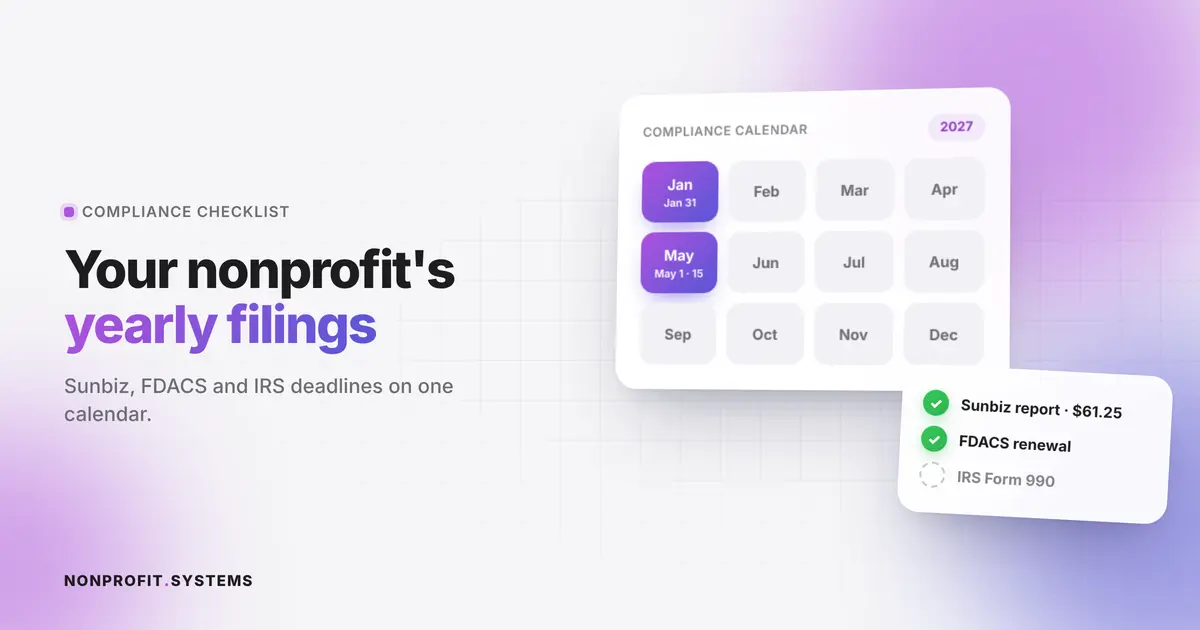
- When: January 1 to May 1, starting the year after you incorporate
- Fee: $61.25
- Where: online only, at Sunbiz.org
The annual report confirms your officers, directors, registered agent and addresses. It is not a financial statement. If you skip it, the State administratively dissolves the corporation later in the year. Reinstatement costs $175 plus the annual report fee for each year you missed.
Tip: use only Sunbiz.org. Every spring, letters from private companies offering to file your annual report for a higher fee reach Florida nonprofits.
2. FDACS charitable solicitation renewal
- Who: charities registered under Florida's Solicitation of Contributions Act (religious institutions are outside this law)
- When: each year, on or before the anniversary of your original approval date
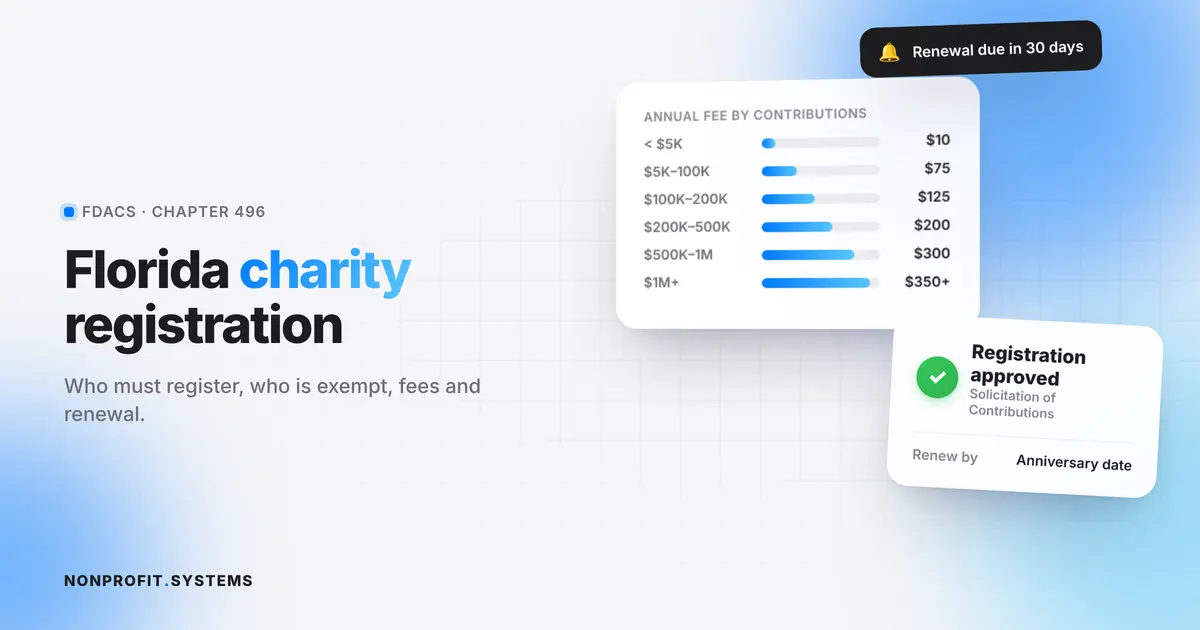
- Fee: $10 to $400, based on last year's contributions
- Late fee: $25 per month
Small volunteer-run charities that use the under-$50,000 exemption also re-file their exemption application every year. Full details: Florida Charitable Solicitation Registration.
3. IRS Form 990 series
- Who: most tax-exempt organizations. Churches and certain church-related organizations are not required to file
- When: the 15th day of the 5th month after your fiscal year ends. For a calendar year, that is May 15
- Extension: available with Form 8868
| Your size | Form |
|---|---|
| Gross receipts normally $50,000 or less | Form 990-N (e-Postcard) |
| Gross receipts under $200,000 and total assets under $500,000 | Form 990-EZ (or full 990) |
| Larger organizations | Form 990 |
| Private foundations | Form 990-PF |
The rule that hurts: if an organization does not file for three consecutive years, the IRS revokes its tax-exempt status automatically. Small groups that forget the five-minute 990-N are the most common victims.
4. Payroll and contractor forms (if you pay anyone)
- Form W-2 to employees and the SSA: by January 31
- Form 1099-NEC to contractors: by January 31. For payments made in 2026 (filed in January 2027), the threshold is $2,000 per contractor. It was $600 through 2025
- Form 941 quarterly payroll tax returns
- Florida reemployment tax quarterly reports, if your organization is liable. Many 501(c)(3) organizations have special rules here, so check with the Florida Department of Revenue
Ministers' compensation has its own tax rules. A church should review this with a CPA who works with churches.
5. Donor acknowledgments
Donors need a written acknowledgment from you to deduct any single gift of $250 or more. Most organizations send year-end statements by January 31. If a donor received goods or services worth something in exchange for a payment over $75 (a gala ticket, for example), you must also give a written disclosure of the deductible amount.
We wrote a full guide for churches: Year-End Giving Statements for Churches.
6. Florida sales tax exemption certificate
Your Consumer's Certificate of Exemption from the Florida Department of Revenue has an expiration date printed on it. Note it in your calendar and renew it ahead of time, otherwise vendors will start charging sales tax.
7. Internal records the board should keep current
These are not filed with anyone, but auditors, grant makers and the IRS can ask for them:
- board meeting minutes, including approval of the budget
- signed conflict-of-interest statements from each director, every year
- updated bylaws
- financial statements reviewed by the board
Florida nonprofit compliance calendar
| Month | What is due |
|---|---|
| January | Donor year-end statements (by Jan 31), W-2 and 1099 (by Jan 31). Sunbiz annual report window opens Jan 1 |
| February to April | File Sunbiz annual report early. Start the 990 with your bookkeeper |
| May | Sunbiz annual report by May 1. Form 990 by May 15 (calendar-year organizations) |
| Every quarter | Form 941, Florida reemployment tax report (if applicable) |
| Your FDACS anniversary | FDACS registration renewal or exemption re-filing |
| November to December | Year-end giving campaign, prepare donor statements, budget approval, board elections |
| Any time | Report changes to FDACS within 10 days. Update Sunbiz when officers or the registered agent change |
How to never miss a filing
Most missed deadlines have the same cause: the information lives in one volunteer's inbox. When that person steps down, the dates go with them.
A simple fix:
- Keep one shared compliance calendar with reminders 60 and 30 days ahead.
- Keep current documents (determination letter, last 990, financial statements, board list) in one shared folder.
- Generate reports and donor statements from the same database you use for donations, so the numbers match.
This is exactly what we build for churches and nonprofits: deadlines, donations, receipts and reports in one admin inside your own website. See document automation for nonprofits or nonprofit workflow automation.
FAQ
When is the Florida nonprofit annual report due?
Between January 1 and May 1 each year, starting the year after incorporation. The fee is $61.25.
What happens if a Florida nonprofit misses the annual report?
The State administratively dissolves the corporation. Reinstatement costs $175 plus each missed year's annual report fee.
Do Florida churches have to file Form 990?
Churches are not required to file Form 990, but an incorporated church still files the Sunbiz annual report.
When is Form 990 due?
On the 15th day of the 5th month after the fiscal year ends, which is May 15 for calendar-year organizations.
What if we do not file a 990 for three years?
The IRS automatically revokes the organization's tax-exempt status.
A practical first step
Free church website audit
Share your website. We will review the visitor experience, mobile layout and the next steps for your church or nonprofit.