Starting a nonprofit in Florida takes two separate approvals. The State of Florida creates your corporation. The IRS decides whether that corporation is tax-exempt under 501(c)(3). Many founders mix these up and lose months, so this guide walks through both in the order that actually works.
You will find the real state fees, the forms, and a checklist at the end. If you are in Palm Beach, Broward or Miami-Dade, our South Florida Nonprofit Guide adds local resources on top of this.
This guide is for general information. For advice on your situation, talk to a nonprofit lawyer or CPA. Fees and forms change, so confirm the current numbers on Sunbiz.org, FDACS.gov and IRS.gov before you file.
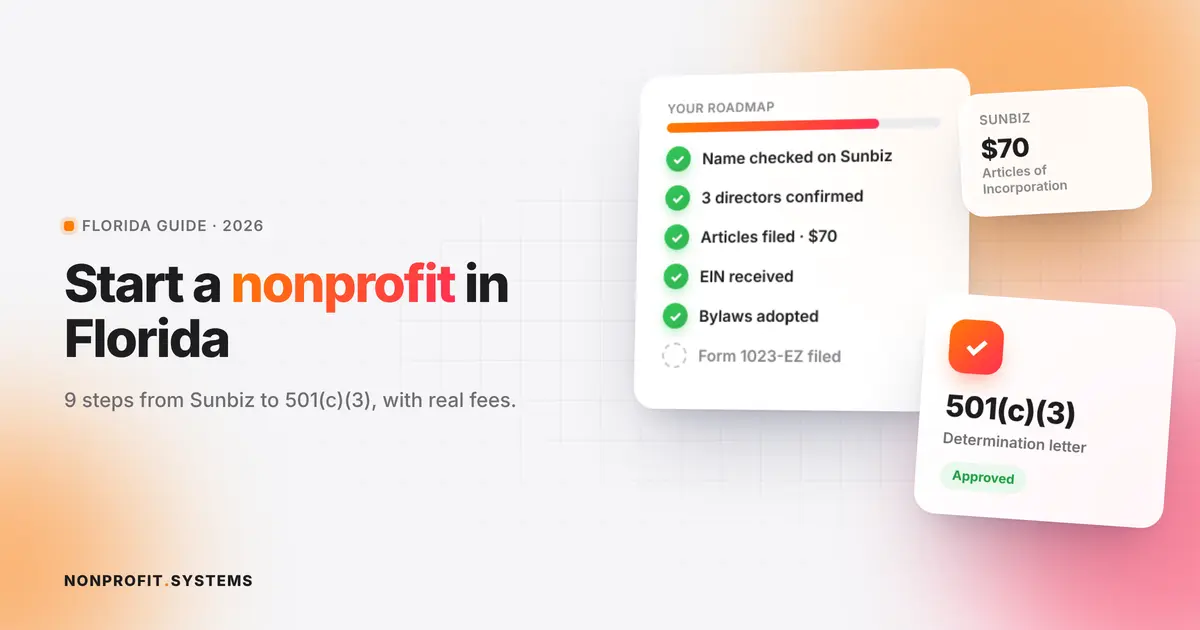
Quick overview: the 9 steps
- Define your mission and check that a nonprofit is the right structure
- Choose a name and check it on Sunbiz
- Recruit at least three directors
- Pick a registered agent in Florida
- File Articles of Incorporation with the Division of Corporations
- Get an EIN from the IRS
- Adopt bylaws and hold your first board meeting
- Apply for 501(c)(3) status
- Register for charitable solicitation and set up your yearly filings
Step 1. Define the mission (and be honest about the structure)
Write one or two sentences that explain who you serve and how. That sentence will go into your Articles of Incorporation, your IRS application and your website, so it is worth getting right.
Ask yourself two questions before filing anything:
- Is there already an organization doing this nearby? Partnering or starting as a program under an existing 501(c)(3) (called fiscal sponsorship) can save you a year of paperwork.
- Will donors need a tax deduction? If yes, you need 501(c)(3) status, and your purpose has to be charitable, religious, educational or scientific.
Step 2. Choose a name and check availability
Search your name on Sunbiz.org. It must be distinguishable from every other entity registered in Florida. Your corporate name usually ends with "Inc." or "Corporation," for example Hope Table Ministries, Inc.
Before you commit, also check that the domain name and social media handles are free. A matching domain makes it much easier for donors to find you later.
Step 3. Recruit at least three directors
Florida law requires a nonprofit corporation to have a board of at least three directors. The IRS also looks more favorably at boards where members are not all related to each other.
Good first boards usually include someone who understands money, someone connected to the community you serve, and someone who will actually show up to meetings.
Step 4. Choose a registered agent
Your registered agent receives legal mail for the corporation. It must be a person or company with a physical Florida street address (no P.O. boxes) who is available during business hours. A director can serve as your registered agent.
Step 5. File Articles of Incorporation on Sunbiz
This is the step that legally creates your Florida domestic not-for-profit corporation under Chapter 617, Florida Statutes. You can file online at Sunbiz or by mail.
State fees (2026):
| Item | Fee |
|---|---|
| Filing fee | $35.00 |
| Designation of registered agent | $35.00 |
| Required total | $70.00 |
| Certified copy (optional) | $8.75 |
| Certificate of status (optional) | $8.75 |
Important for 501(c)(3): your Articles must include a purpose clause limited to exempt purposes and a dissolution clause that sends remaining assets to another 501(c)(3) if you ever close. The basic Sunbiz form does not add this language for you. Check the IRS sample language before you file. Fixing Articles later costs another filing fee and delays your IRS application.
Step 6. Get an EIN (free)
Apply for an Employer Identification Number on IRS.gov. It is free and takes a few minutes online. You need the EIN to open a bank account, apply for 501(c)(3) and accept online donations. Ignore websites that charge for an EIN.
Step 7. Adopt bylaws and hold your first board meeting
Bylaws are your internal rules: how directors are elected, how many make a quorum, who signs checks, how meetings are called. At the first board meeting, the board should:
- adopt the bylaws
- elect officers (president, secretary, treasurer)
- adopt a conflict-of-interest policy
- approve opening a bank account
- authorize the 501(c)(3) application
Keep written minutes. The IRS and future grant funders may ask for them.
Step 8. Apply for 501(c)(3) status with the IRS
You apply online through Pay.gov.
| Form | IRS user fee | Who it is for |
|---|---|---|
| Form 1023-EZ | $275 | Smaller organizations that pass the IRS eligibility worksheet (generally projected gross receipts of $50,000 or less a year and assets of $250,000 or less) |
| Form 1023 | $600 | Everyone else, and anyone who fails any question on the EZ worksheet |
Complete the Form 1023-EZ eligibility worksheet honestly. The fee is not refunded if you file the wrong form.
Churches: the IRS treats churches as tax-exempt automatically, so applying is optional. Many churches still apply because a determination letter makes it easier to receive grants, open accounts and reassure donors.
Step 9. Register with the State and set up yearly filings
Once you are a corporation, a few state-level items follow:
- Charitable solicitation registration. Most charities must register with the Florida Department of Agriculture and Consumer Services (FDACS) before asking the public for donations. Bona fide religious institutions are outside this law. See our full guide: Florida Charitable Solicitation Registration.
- Sales tax exemption. After you receive your 501(c)(3) letter, you can apply to the Florida Department of Revenue for a Consumer's Certificate of Exemption so purchases for your mission are not taxed.
- Annual report. Every Florida nonprofit corporation files an annual report on Sunbiz between January 1 and May 1, starting the year after formation. The fee is $61.25.
- IRS Form 990. Most exempt organizations file a 990, 990-EZ or 990-N every year.
We collected every recurring deadline in one place: Florida Nonprofit Annual Filing Requirements.
What it costs to start a nonprofit in Florida
| Item | Typical cost |
|---|---|
| Sunbiz Articles of Incorporation | $70 |
| EIN | Free |
| IRS Form 1023-EZ or 1023 | $275 or $600 |
| FDACS registration (first year) | $10 to $75 for most new charities |
| Government fees, total | about $355 to $745 |
Optional costs include a lawyer or CPA to review your Articles and IRS application, a website, and a donation platform.
After approval: the part most guides skip
Getting your 501(c)(3) letter is where the real work starts. Within the first few months you will need:
- a website that explains your mission and accepts donations
- a way to send donor receipts (and year-end statements)
- sign-up forms for volunteers and the people you serve
- a calendar of filing deadlines so nothing lapses
New nonprofits usually patch this together from five or six separate apps. At NONPROFIT.SYSTEMS we build it as one connected system inside your own website: donations, forms, registrations, receipts and reports in a single admin your volunteers can run. If you are a church, see church website design in South Florida. For other organizations, start with nonprofit workflow automation.
Explore the free and discounted software available to nonprofits before choosing subscriptions for your new organization.
Checklist: starting a nonprofit in Florida
- Mission statement written
- Name checked on Sunbiz, domain reserved
- Three or more directors confirmed
- Registered agent with a Florida street address
- Articles of Incorporation filed with 501(c)(3) purpose and dissolution clauses
- EIN received
- Bylaws and conflict-of-interest policy adopted, minutes recorded
- Bank account opened
- Form 1023-EZ or 1023 filed on Pay.gov
- FDACS registration (or exemption) filed before fundraising
- Consumer's Certificate of Exemption requested from Florida DOR
- Annual report reminder set for January
- Website, donations and receipts set up
FAQ
How much does it cost to start a nonprofit in Florida?
The state charges $70 to file Articles of Incorporation. The IRS charges $275 (Form 1023-EZ) or $600 (Form 1023) for 501(c)(3). Most new charities also pay a small FDACS registration fee, usually $10 to $75.
How many board members does a Florida nonprofit need?
At least three directors.
Can I start a nonprofit by myself in Florida?
You can file the paperwork yourself, but you still need at least three directors on the board.
Is a Florida nonprofit corporation automatically a 501(c)(3)?
No. The State creates the corporation. 501(c)(3) status comes from the IRS after you file Form 1023 or 1023-EZ.
When is the Florida nonprofit annual report due?
Between January 1 and May 1 every year, starting the year after you incorporate. The fee is $61.25.
Do churches in Florida need to register with FDACS?
Bona fide religious institutions are outside Florida's Solicitation of Contributions Act, so they generally do not register.
A practical first step
Free church website audit
Share your website. We will review the visitor experience, mobile layout and the next steps for your church or nonprofit.