Church staff and volunteers are already using AI. Someone drafts the bulletin with ChatGPT, someone else asks Claude to summarize a long denominational report. Usually this happens quietly, on personal accounts, with no shared rules.
AI can save a small church team many hours a week. It also raises real questions about privacy, accuracy and what belongs to the pastor's own voice. This guide gives you practical uses, clear limits and a one-page policy you can adapt.
Where AI genuinely helps a church team
Communication
- first drafts of announcements, newsletters, event descriptions and social posts
- turning one sermon into a short recap, a small-group discussion guide and three social captions
- translating announcements for multilingual congregations (have a native speaker check before publishing)
Administration
- summarizing long documents: board minutes, policies, insurance or denominational reports
- drafting volunteer job descriptions, sign-up instructions and training checklists
- organizing messy notes into a clear plan for an event like VBS or a food distribution
Grants and fundraising
- first drafts of grant narratives from your program data
- donor thank-you letters and campaign updates
- checking that an application answers every question the funder asked
Ministry support
- lesson plan ideas for children's ministry, adapted to age groups
- Bible study question sets on a passage the leader chooses
- event logistics: schedules, shopping lists, volunteer shift plans
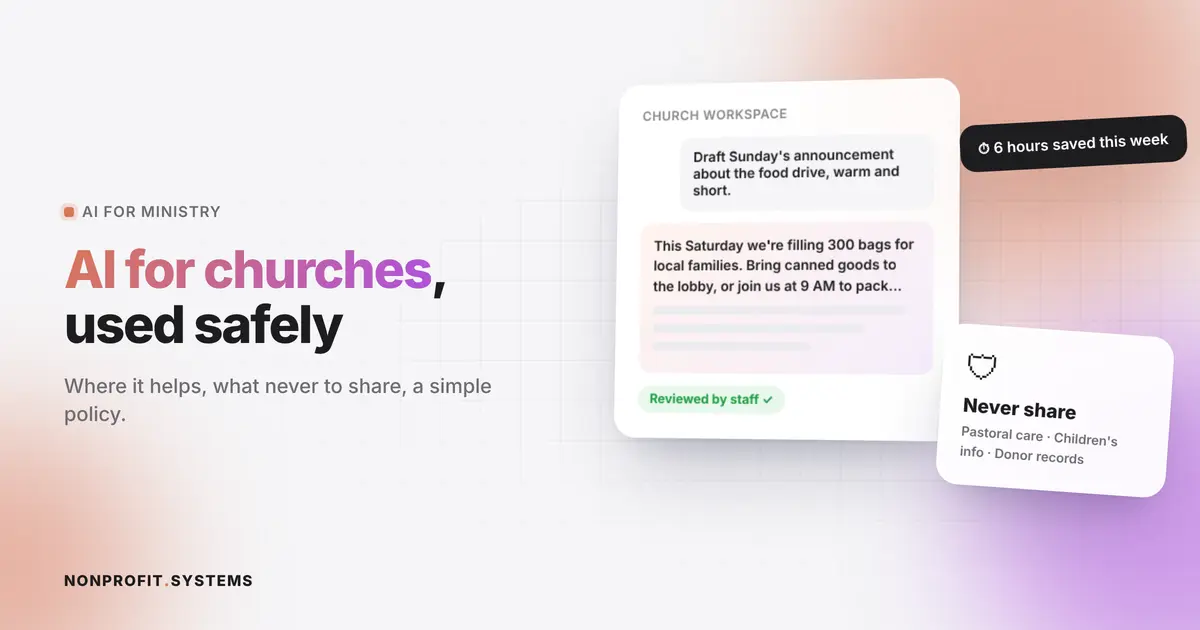
In every case, AI produces a first draft. A person who knows your church reviews, corrects and owns the final version.
What never goes into an AI tool
This is the most important part of any church AI policy:
- Pastoral care and counseling details: confessions, marriage issues, mental health, addiction, anything shared in confidence
- Information about children: names with photos, medical notes, custody details
- Member and donor records: giving amounts, home addresses, phone numbers, financial hardship
- Anything you would not want read aloud in a board meeting
If you need AI help with a sensitive situation, describe it in general terms with no names or identifying details.
Personal accounts vs. an organization account
Free personal accounts are where most privacy risk comes from: data is scattered across people's private logins, and nobody can manage or remove access when a volunteer leaves.
A team or organization plan gives you:
- one place where the church controls access and can remove users
- shared projects with your church's own context (beliefs statement, style guide, ministry calendar), so drafts sound like your church
- business data terms. Read the provider's privacy terms to see how your data is handled and whether it is used for training
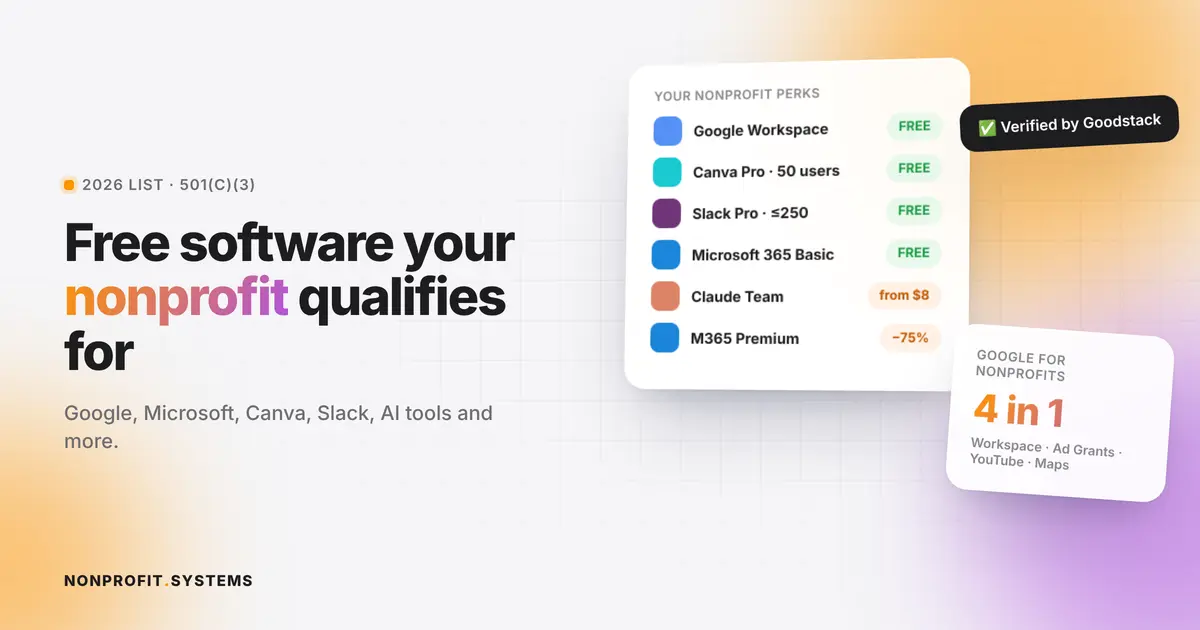
Both major providers now offer nonprofit pricing. Claude for Nonprofits (Anthropic) offers discounted Team and Enterprise plans, with Team seats starting at $8 per user per month for verified nonprofits. OpenAI offers nonprofit discounts on ChatGPT Business and Enterprise. See our full list of software discounts for 501(c)(3) organizations.
Questions churches ask
Should pastors write sermons with AI? That is a decision for each pastor and church leadership. Many use AI for research support, outlines or illustrations and keep the message itself their own. Whatever you decide, put it in your policy so the congregation can trust what they hear.
Is AI accurate about the Bible and theology? Not always. AI can misquote verses, mix up translations or present one tradition's view as the only one. Always check quotations against your Bible translation and review theological content carefully.
Will AI replace church staff? In small churches, it mostly gives back time for people work: visits, calls, discipleship. It does not replace the relationships at the center of ministry.
A one-page church AI policy (template)
- Purpose. We use AI tools to save time on drafts, summaries and administration, so staff and volunteers can spend more time with people.
- Approved tools. Only [tool name] through the church's organization account. No church data in personal AI accounts.
- Never share. Pastoral care details, information about children, member and donor records, or anything shared in confidence.
- Human review. Every AI draft is reviewed and edited by a person before it is published or sent. That person is responsible for it.
- Accuracy. Scripture quotations, dates, names and numbers are always checked against the source.
- Preaching and teaching. [Your church's decision on AI in sermons and lessons.]
- Transparency. We are open about using AI for administrative work when asked.
- Access. The [role] manages accounts and removes access when someone leaves.
- Review. This policy is reviewed every year by church leadership.
How to start in one month
- Week 1: leadership agrees on the policy above
- Week 2: set up an organization account with nonprofit pricing
- Week 3: create a shared project with your church's basics: beliefs, style, ministries, calendar
- Week 4: a one-hour hands-on training for staff and key volunteers, with real tasks from their week
At NONPROFIT.SYSTEMS, we set up AI tools for churches and nonprofits, connect them to the church's website and systems, and train teams to use them safely. AI also works best when your data is organized: see document automation for nonprofits.
FAQ
How can churches use AI?
For first drafts of announcements and newsletters, summarizing documents, grant writing, lesson planning and event logistics, always with human review.
Is it safe for churches to use AI?
Yes, with rules: use an organization account, never share pastoral care, children's or donor information, and review every draft before it is used.
Do churches need an AI policy?
Yes. A one-page policy sets clear limits on what can be shared, who reviews drafts and how AI is used in teaching.
Is there nonprofit pricing for AI tools?
Yes. Anthropic's Claude for Nonprofits and OpenAI's nonprofit program both offer discounts for verified nonprofits.
A practical first step
Free church website audit
Share your website. We will review the visitor experience, mobile layout and the next steps for your church or nonprofit.