Every January, church offices across the country spend days pulling giving records, fixing names and printing envelopes. Donors need those statements to claim their tax deductions, and a single wrong total means a correction letter and an awkward conversation.
This guide explains what the IRS requires, gives you a template you can adapt, and shows how to make the whole process run automatically next year.
For general information only. See IRS Publication 1771 and talk to your CPA about your church's specific situation.
Why year-end statements matter
Under IRS rules, a donor cannot deduct any single contribution of $250 or more without a contemporaneous written acknowledgment from the church. "Contemporaneous" means the donor has it by the time they file their tax return (or by the return's due date, if earlier). That is why most churches send statements by January 31.
A few details people often get wrong:
- The $250 rule applies to each separate gift. Weekly offerings of $100 are not added together for this test, even if the yearly total is $5,200.
- Donors still need records for smaller gifts (a bank record or written communication from the church), so a statement covering every gift is the cleanest solution.
- The church is not penalized for skipping a $250 acknowledgment, but your donors lose their deduction, and they will remember it.
What a church giving statement must include
- The church's legal name (and it is good practice to add the EIN and address)
- The donor's name
- The amount of each cash contribution, or a total with dates if you list gifts by period
- A description (not the value) of any non-cash gifts, such as "one used Toyota Camry" or "10 boxes of canned food"
- A statement about goods or services, one of these:
- "No goods or services were provided in exchange for these contributions," or
- "Only intangible religious benefits were provided in exchange for these contributions," or
- a description and good-faith estimate of the value of goods or services provided
Churches can use the "intangible religious benefits" wording. It covers things like worship services and spiritual guidance that have no market value.
The $75 quid pro quo rule
If a donor pays more than $75 and receives something of value in return (a banquet ticket, a gift basket, a dinner), the church must give a written disclosure that:
- the deductible amount is only the part above the value of what they received, and
- states a good-faith estimate of that value.
Example: a donor pays $150 for a fundraising dinner worth $40. The disclosure tells them $110 is deductible. The IRS can charge a penalty of $10 per contribution (up to $5,000 per event or mailing) for missing disclosures. Token items of small value are excluded.
Sample year-end giving statement
Grace Community Church, Inc. 123 Main Street, Boca Raton, FL 33432 · EIN 00-0000000
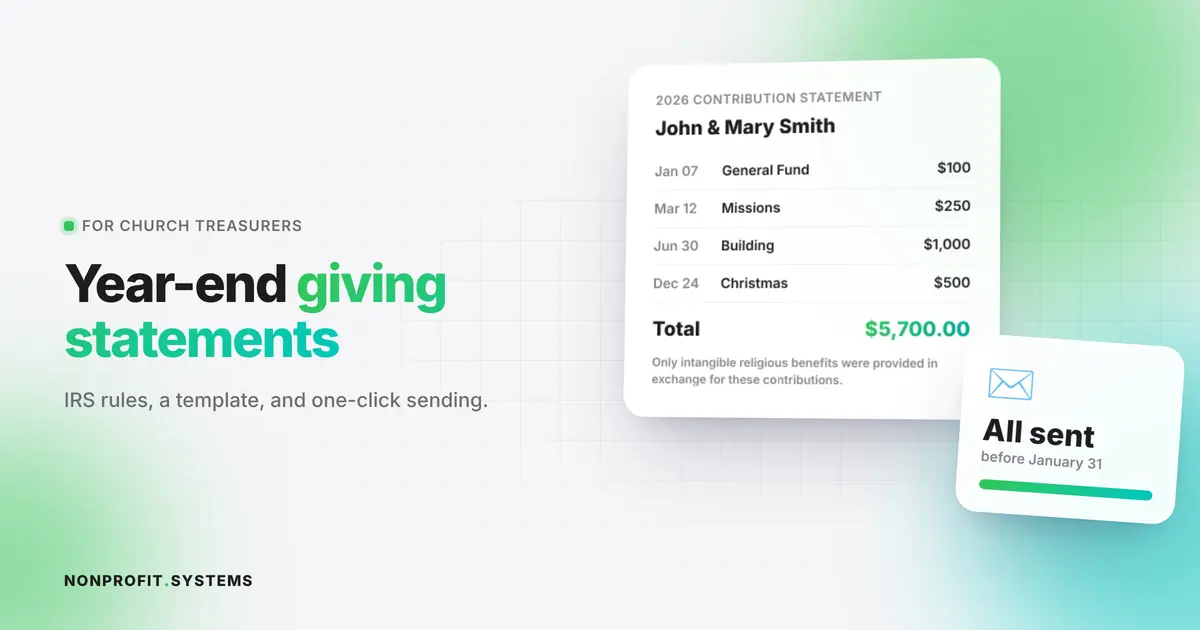
2026 Contribution Statement Prepared for: John and Mary Smith, 45 Palm Ave, Delray Beach, FL 33444
Date Fund Amount 01/07/2026 General Fund $100.00 01/14/2026 General Fund $100.00 ... ... ... 12/24/2026 Christmas Missions $500.00 Total $5,700.00 Non-cash gifts: Furniture donated to the Family Shelter Ministry on 06/12/2026 (description only; the donor determines value).
Only intangible religious benefits were provided in exchange for these contributions.
Thank you for your faithful generosity this year. Your giving helped us serve [short impact line].
Questions about this statement? Contact finance@gracechurch.org by February 15.
Keep the thank-you line real and specific. A statement is one of the few documents every giving family reads, so it is a good place to share one sentence about what their gifts made possible.
The manual process (and where it breaks)
The usual January routine:
- Export gifts from the online giving tool.
- Add cash and check gifts from the offering spreadsheet.
- Merge duplicates ("Bob Smith," "Robert Smith," "R. Smith").
- Mail-merge statements into Word.
- Print, stuff envelopes, email the rest.
- Fix the mistakes donors report.
Steps 2 and 3 cause most errors. When gifts live in more than one place, someone has to stitch them together by hand.
How to automate year-end statements
An automated setup looks like this:
- One donor database. Online gifts, offering-envelope gifts and event payments all land on the same donor record.
- Approved template. Your treasurer approves the wording once, including the IRS language above.
- One click in January. The system totals each donor's gifts, builds a PDF statement per household and emails it. Paper copies print as one batch for the people who want them.
- Self-service. Donors can download past statements from their account on your church website, so the office stops getting "can you resend my statement" emails in April.
- Audit trail. Every statement sent is stored with a date.
This is one of the connectors we build into church websites at NONPROFIT.SYSTEMS. It sits inside the same admin as your online giving, events and registrations, so the numbers always match. Read more about document automation for nonprofits, or see our approach to church websites in South Florida.
Year-end checklist for church treasurers
- All cash and check gifts entered by the last Sunday of December
- Duplicate donor records merged
- Non-cash gifts described (without values)
- Quid pro quo events reviewed (anything over $75 with a benefit)
- Template wording approved by the treasurer or CPA
- Statements sent by January 31
- Copies saved
- Correction requests handled by mid-February
FAQ
Are churches required to send year-end giving statements?
Donors need a written acknowledgment for any single gift of $250 or more to deduct it. Because of that, nearly all churches send annual statements to every giving household.
When should churches send year-end contribution statements?
Most send them by January 31 so donors have them before filing taxes.
What wording should a church use on giving statements?
Include either "No goods or services were provided" or "Only intangible religious benefits were provided in exchange for these contributions," plus details of any goods or services if applicable.
Should a church put a value on donated items?
No. The church describes non-cash gifts. Valuing them is the donor's responsibility.
Can year-end giving statements be emailed?
Yes. Email or PDF statements are acceptable written acknowledgments. Offer paper copies for donors who ask.
A practical first step
Free church website audit
Share your website. We will review the visitor experience, mobile layout and the next steps for your church or nonprofit.